


ABOUT THE EXHIBITION
Exhibition Diaghilev. “Russian Seasons.” Dress Rehearsal.
Sergei Diaghilev was a prominent figure in the theater and arts of the 20th century, an impresario, and the creator of the triumphant Russian Seasons, which introduced the greatness of Russian art to a global audience. But what do Diaghilev’s ballets and mosaics have in common? Their captivating similarity, of course, lies in their pursuit for harmony through diversity! Just as ballet is a unity of the dancers’ movements, the plasticity of the costumes and sets, and lighting effects, so does the art of mosaic forming an amazing holistic image of smallest details.
This concept formed the basis of our exhibition, where participants collaborate to create their own works on a common theme, demonstrating how art can unite people. Mosaic, as a technique for creating images of small fragments, perfectly reflects the idea of creating a whole of details. The exhibition in the Kingdom of Thailand includes a sketch for the Russian Ballets poster created by Jean Cocteau in 1911, sketches of the sets for I. Stravinsky’s iconic ballet The Firebird, and sketches of the costumes for N. Rimsky-Korsakov’s ballet The Golden Cockerel.
Exhibition structure:
The exhibition Diaghilev. “Russian Seasons.” Dress Rehearsal. begins with a mosaic work depicting a sketch for the Ballets Russes poster, created by Jean Cocteau in 1911, and this is done on purpose.
Jean Cocteau was a French writer, poet, playwright, painter, screenwriter, and film director. He was one of the most significant figures in 20th-century French culture. Cocteau gained widespread fame after he started collaboration with Sergei Diaghilev’s ballet company. «In 1912, Diaghilev’s Russian Ballets <…> stunned and awakened Cocteau,» wrote André Maurois. After seeing performances of the Diaghilev company, Cocteau embarked on a new stage in his creative life.
This is the only exhibit that refers to the work of a foreign artist, which manifests the importance of collaboration between international artists for the development of world culture.
The exhibition further explores the works of Natalia Goncharova, a Russian painter, graphic artist, and a prominent figure of the Russian avant-garde. In 1914, on the recommendation of Alexandre Benois, Diaghilev invited Goncharova to Paris to work on The Golden Cockerel (first version).
The exhibition Diaghilev. “Russian Seasons.” Dress Rehearsal. features mosaic works based on Goncharova’s sketches of the sets for Igor Stravinsky’s legendary ballet The Firebird (1926 ) and costume sketches for the second version of The Golden Cockerel (1930s).
The mosaic panels on the theme of Goncharova’s sketches for The Firebird serve as a frame for the works based on her costume sketches for The Golden Cockerel, forming a circular composition, as in her in her work on the second version of The Golden Cockerel Goncharova drew on folklore and her previous creations, including the ones for The Firebird.
The exhibition Diaghilev. “Russian Seasons.” Dress Rehearsal. offers audio guides featuring music by the great Russian composers Igor Stravinsky and Nikolai Rimsky-Korsakov.
MOSCOW SCHOOL OF MOSAIC
MOSCOW SCHOOL OF MOSAIC
The school was founded in Moscow in 2017.
School of mosaic offers professional training in the art of mosaic for adults.
The School actively develops exhibition activities and organizes exhibitions of mosaic art.
Mosaic School teachers are graduates of leading Russian art schools. The school utilizes classical Russian and contemporary Italian teaching methods. School graduates continue their work in Open Workshops, where they collaborate with supervising artists to create works for exhibition projects.
Specially for this exhibition, the Moscow School of Mosaic provided mosaic panels inspired by sketches for Sergei Diaghilev’s «Russian Seasons» created by Russian artists.
Just as ballet is a unity of the dancers’ movements, the plasticity of the costumes and sets, and lighting effects, so does the art of mosaic forming an amazing holistic image of smallest details.
The exhibited works are made of stained glass and smalt using modern mosaic technique.
The artists are representatives of a wide range of professions and are trained by professional artists at the Moscow School of Mosaic.
Each mosaic is unique. Each element is hand-carved.
The average time spent creating a mosaic based on a costume sketch is 60 hours.
The average time spent creating a mosaic based on a set sketch is 150 hours.
1
Exhibit: Sketch of the Russian Ballets poster (Jean Cocteau, 1911)
Author: Polina Andreeva
Stained glass, 2025
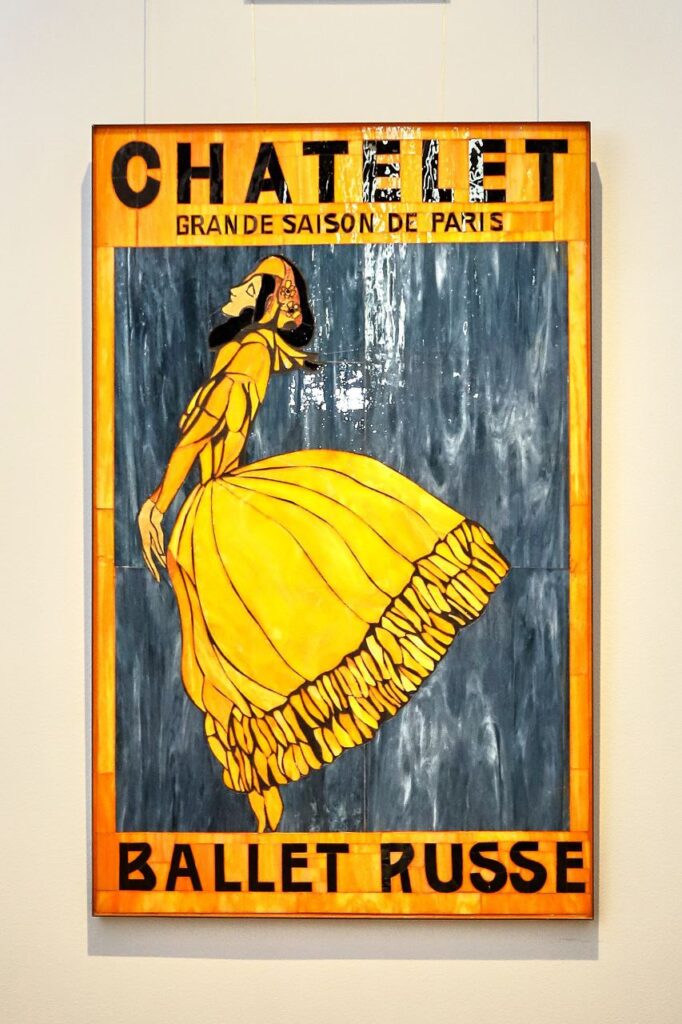
Description: This mosaic was created by the leading teacher of the Moscow School of Mosaic, artist Polina Andreeva, based on a sketch from the poster for the 1911 Russian Seasons created by Jean Cocteau.
The design of this sketch was inspired by the poster for the ballet Le Spectre de la Rose based on a poem by Theophile Gautier, which was staged on 19 April 1911 by Mikhail Fokine.
Interestingly, the poster design was created not by the artist Léon Bakst, who was a set designer for the production, but by the French cultural luminary Jean Cocteau.
The poster is designed in the spirit of the Art Nouveau era, which focused on the visual image rather than the accentuated titles and names of the ballet dancers. The poster’s laconic and graphic style symbolizes the exquisiteness of the main character.
In the original poster the artist depicted a black-and-white female figure on a blue background, highlighted only by a rosy blush on her face.
The author of this mosaic piece, Polina Andreeva, reworked the sketch’s color scheme, adding vibrancy through the iridescent stained glass. The vibrant orange is a reference to the signature color of the Moscow School of Mosaic.
The panel is made using a modern mosaic technique. Each letter is hand-carved by the artist.
2
Exhibit: Set design sketch for I. Stravinsky’s ballet The Firebird. The City (Natalia Goncharova, 1926 г.)
Authors: Olga Levina and Vladislava Kirkina
Stained glass, 2025
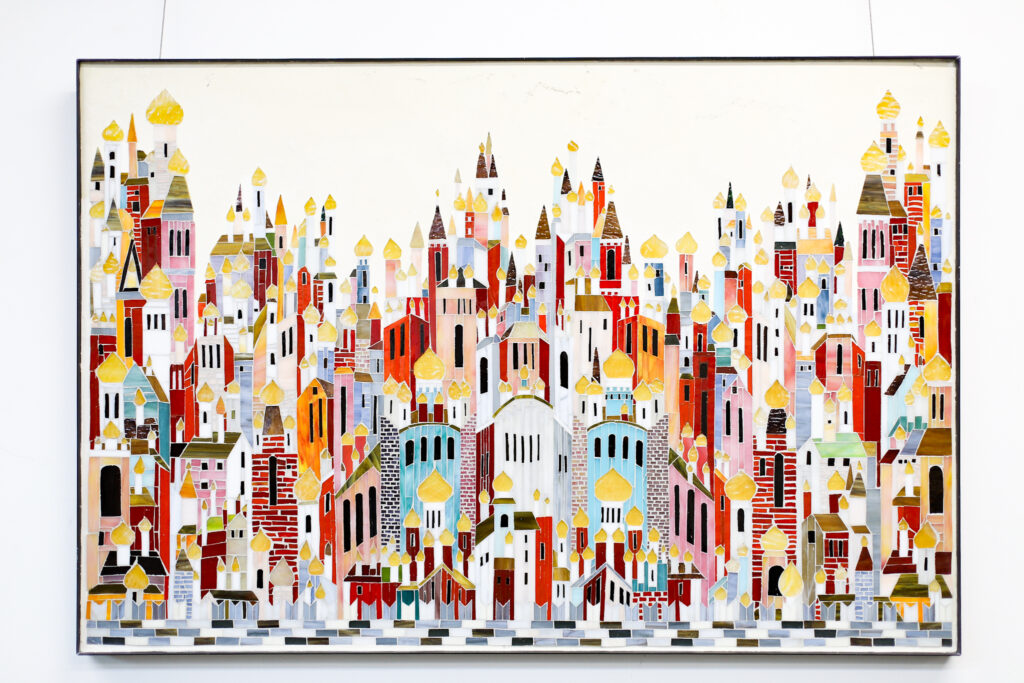
Description: The Firebird was staged twice by Sergei Diaghilev’s company. In 1910 it was staged with sets and costumes by A. Golovin and L. Bakst.
Mikhail Fokine wrote in his memoirs: «My idea was to change the set: after Kashchei’s death, after the victory of good over evil, the gloomy ‘filthy kingdom’ was to be replaced by a kingdom of light and joy. All the colors were to be different in the second set. But… it wasn’t commissioned by Diaghilev, and all the joy of the finale took place against a ‘filthy’ backdrop!»
In 1926, Diaghilev invited Natalia Goncharova as a set designer for the revival of the ballet, and she kept to the choreographer’s original vision: in the new production, the action ended against a backdrop depicting a Russian city behind a fortress wall, with white-stone chambers and golden-domed cathedrals.
This mosaic is unique as it was created by two artists: Olga Levina and Vladislava Kirkina.
It was completed in record time, taking just over a month, without any detriment to its quality: look how precisely the domes of the churches in this magical city are carved. And there are over 250 of them!
The artists’ tandem are a mother and daughter, who have been studying together in the workshops of the Moscow School of Mosaic for several years. They participate in almost all of the School’s exhibition projects.
3
Exhibit: Sketch of a panel after the story of the ballet The Golden Cockerel by N. Rimsky-Korsakov. Guidon
(Natalia Goncharova, 1930-s)
Author: Elena Kupriyanova
Stained glass, 2025
act I: “Noch’ vsiu dumal do zari” (I thought all night until dawn)
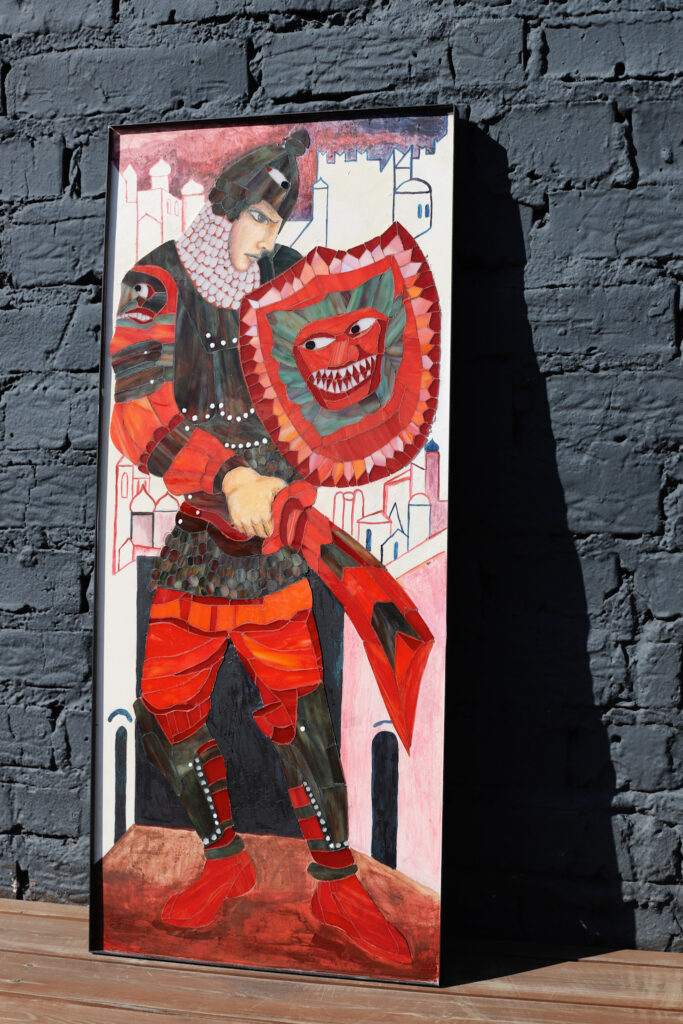
Description: Despite enthusiastic reactions from audiences and critics, the production quickly disappeared from the repertoire and was revived only in 1937. By this time, Goncharova no longer had the costume and set designs from 1914 (they had been dispersed among museums and private collections), so she recreated them.
Essentially, the sketch displayed at the exhibition is a part of a stained glass mosaic diptych based on sketches by Natalia Goncharova: Polkan and Gvidon.
As in the case of Polkan, in Pushkin’s original text of A Tale of the Golden Cockerel, the tsar’s son is not given a name; it appeared in the libretto for Rimsky-Korsakov’s opera.
The composition Guidon was chosen for a mural in the mansion of Sergei Koussevitzky, the renowned double bass player and conductor. Goncharova worked on the decoration of his Parisian mansion and for the hallway she created a series of theatrical murals based on productions by Diaghilev’s company.
The artist, a resident of the Moscow School of Mosaic’s Open Workshops Elena Kupriyanova, was inspired not only by Natalia Goncharova’s sketch but also by the Adepts of Red exhibition at the Tretyakov Gallery, and used various shades of red stained glass in her work.
After completing the mosaic, Elena Kupriyanova saw a ballet about Sergei Diaghilev at the Bolshoi Theater. Thus, working on the mosaic became an illustration of global links in art for the artist.
4
Exhibit: Sketch for a mural based on the ballet The Golden Cockerel by N. Rimsky-Korsakov. Polkan (Natalia Goncharova, 1930-s)
Author: Vladislava Kirkina
Stained glass, 2025
(Ki-ri-ki! Ki-ri-koo-koo! Watch out, be on your guard!)
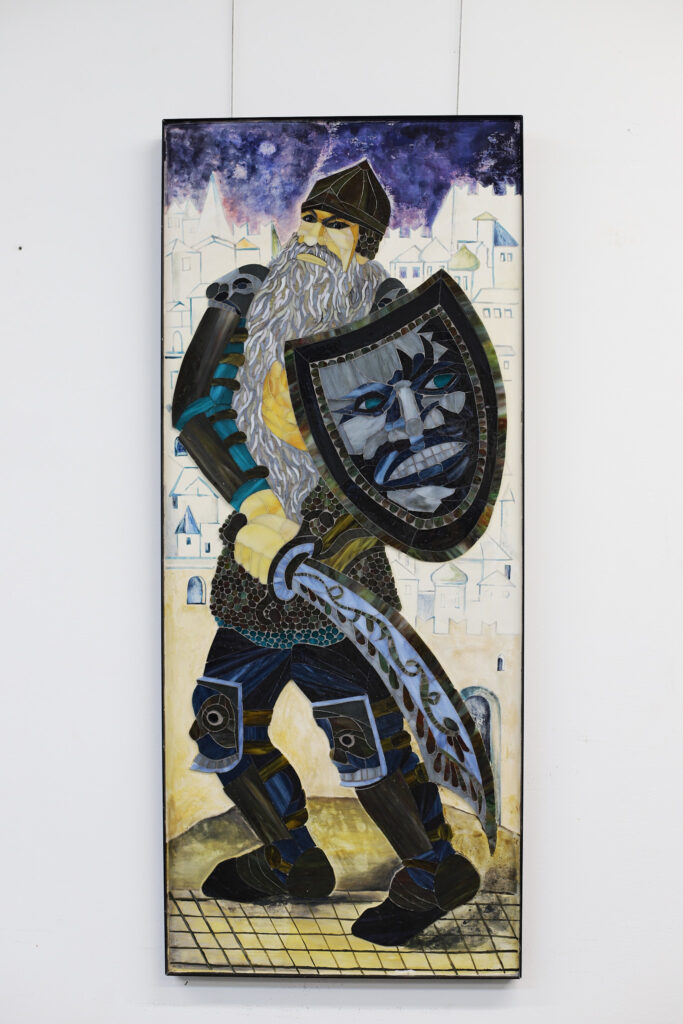
Description: A mosaic based on Natalia Goncharova’s costume design for Polkan was created by Vladislava Kirkina, a resident artist of the Moscow School of Mosaic’s Open Workshops.
Technique: modern mosaic. Material: stained glass.
While working on the mosaic, the author reread both Pushkin’s fairy tale and the libretto for Rimsky-Korsakov’s opera, as the name of the Tsar’s vaivode (army commander) was not mentioned in the original tale. The name “Polkan” was first used in the opera The Golden Cockerel, based on A.Pushkin’s The Tale of the Golden Cockerel.
Natalia Goncharova created the image of a gray-haired, wise old man who tries to protect the tsar from trouble.
Vladislava Kirkina demonstrated her mastery in mosaic art, creating all the costume details, the shield, and even the hero’s face from stained glass.
The background, however, is painted for contrast.
It is worth noting that this isn’t Vladislava’s only work featured at the exhibition; all of her works demonstrate virtuoso skill.
5
Exhibit: Costume sketch for the ballet The Golden Cockerel by N. Rimsky-Korsakov. Peasant woman in a sarafan
(Natalia Goncharova, 1937)
Author: Olga Koluzganova
Smalt, 2025
act I: “V bane grusten tsar sidit” (Tsar is sad, sitting in the bath house)
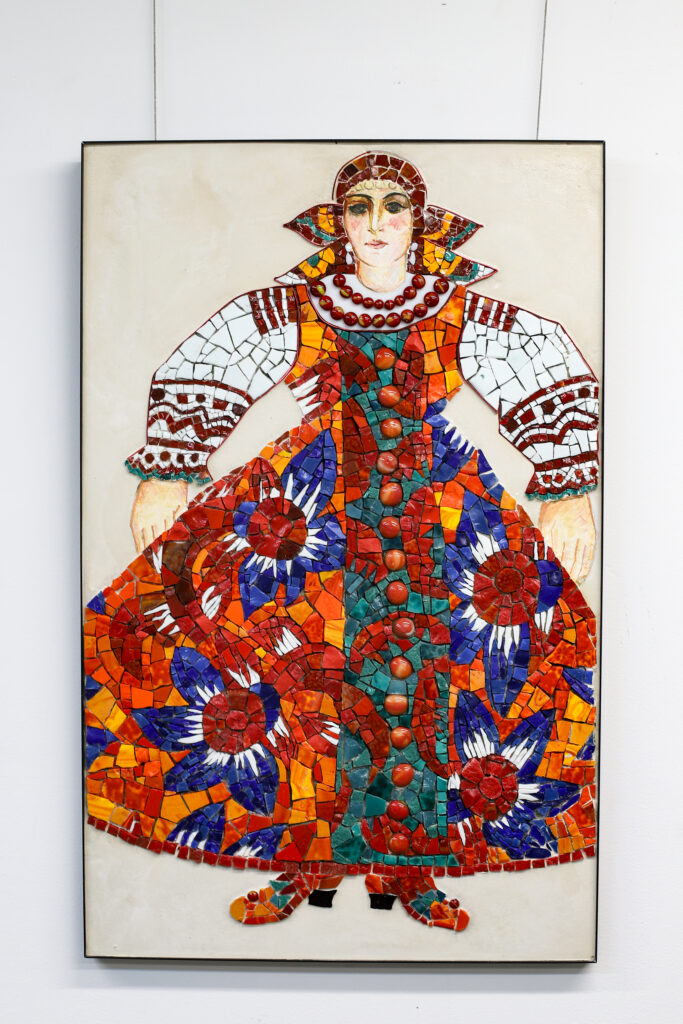
Description: Another mosaic based on Natalia Goncharova’s costume sketch for the ballet The Golden Cockerel.
Made of smalt, a traditional mosaic material.
Smalt is glass fused with metallic oxides, allowing for a wide range of colors and shades. Smalt is known for its durability: it was used to create many Byzantine-era mosaics that have survived to this day.
The heroine’s face, on the other hand, is not made of smalt but is painted using a fresco technique — paints on wet plaster.
By combining mosaic and painting techniques, the artist, Olga Koluzganova, has created an unusual and radiant work that is true to the spirit of Natalia Goncharova’s original sketch.
6
Exhibit: Costume design for the ballet The Golden Cockerel by N. Rimsky-Korsakov. The Tsar (Natalia Goncharova, 1937)
Author: Galina Kornyukhina
(Ki-ri-ki! Ki-ri-koo-koo! Reign while lying on your side)
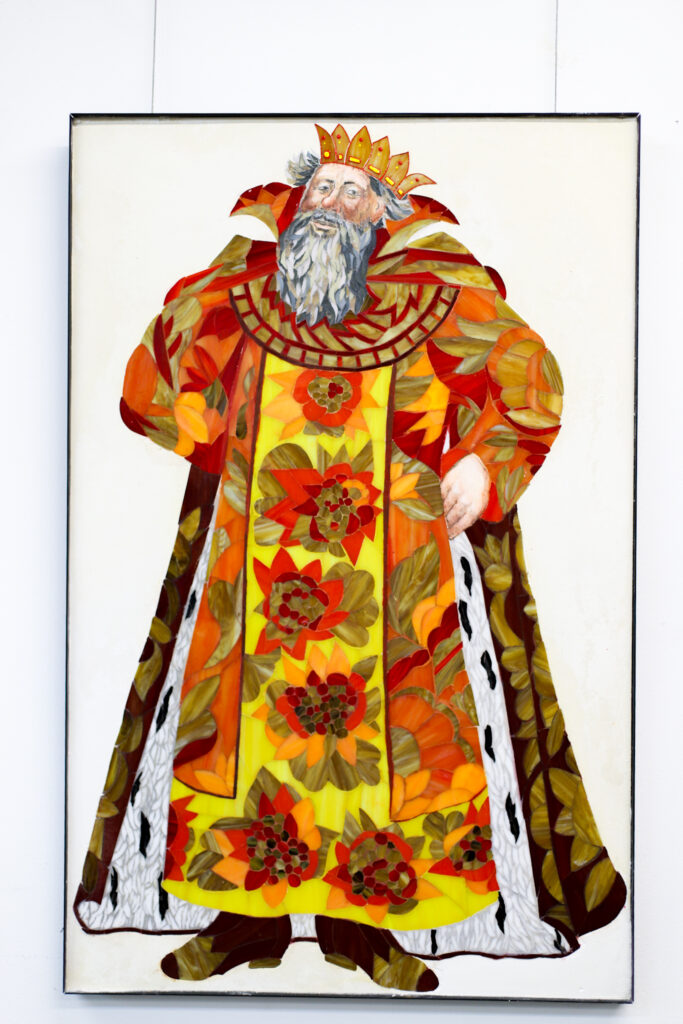
Description: The Tsar is one of the central characters in the ballet The Golden Cockerel.
Natalia Goncharova took a particularly meticulous approach to creating his image. And the mosaic’s creator, Galina Kornyukhina, a resident of the Moscow School of Mosaic’s Open Workshops, embodied this sketch into stained glass with scrupulous precision.
An interesting fact: although the mosaic is an exact replica of Natalia Goncharova’s original sketch, the final image of the Tsar, crested in modern mosaic technique, bears a striking resemblance to the artist’s husband. This may be because Galina Kornyukhina spent over 60 hours in the workshops working on this sketch.
7
Exhibit: Costume sketch for the ballet The Golden Cockerel by N. Rimsky-Korsakov. Female Dancer (Natalia Goncharova, 1937 г.)
Author: Veronika Belova
Stained glass, 2025
act II: “Otvet’ mne, zorkoye svetilo” (Answer me, sharp-eyed star)
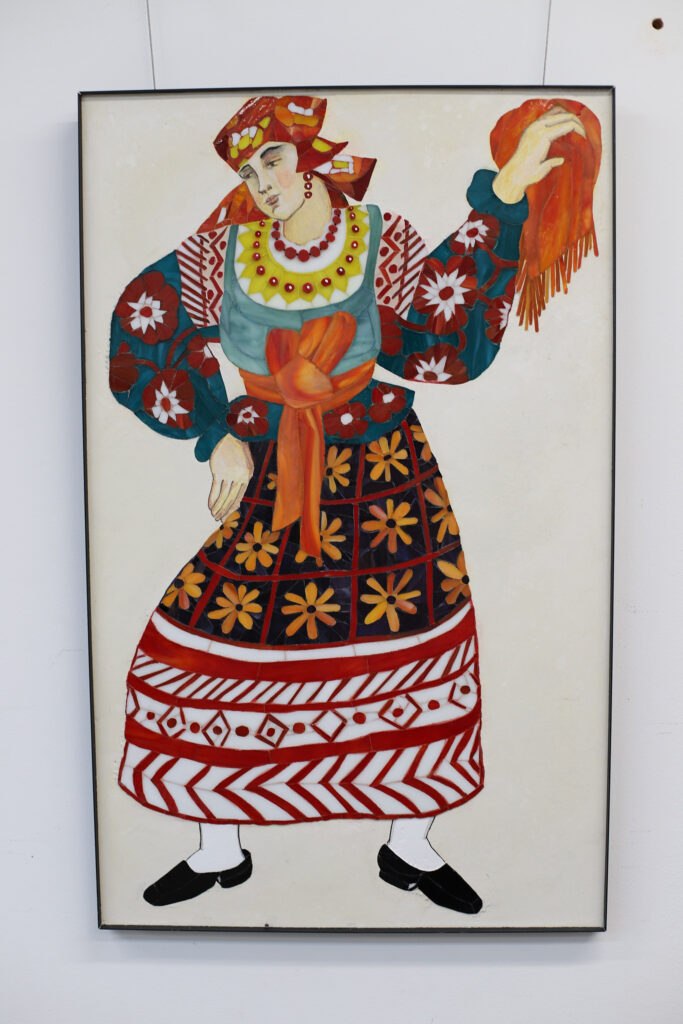
Description: In her costume designs, Goncharova drew on folklore and her previous work for the ballets The Wedding and The Firebird.
The mosaic was made of stained glass by Veronika Belova, a resident artist of the Moscow School of Mosaic’s Open Workshops.
Veronika chose this sketch inspired by the girl’s vibrant costume and dynamic pose, and successfully conveyed in the mosaic the character’s flirtatious nature.
8
Exhibit: Set design sketch for I. Stravinsky’s ballet The Firebird. Night (Natalia Goncharova, 1926)
Author: Olga Levina
Stained glass, 2025
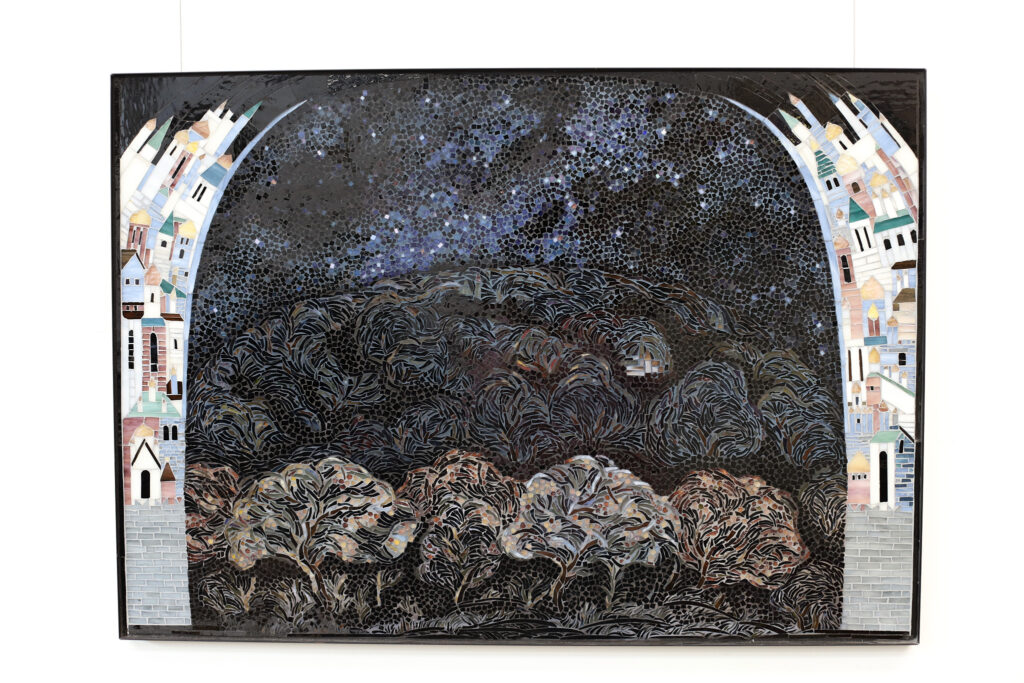
Description: The Firebird was staged twice by Sergei Diaghilev’s company. In 1910 it was staged with sets and costumes by A. Golovin and L. Bakst. The ballet was revived in 1926.
However, the original sets were lost, and Diaghilev invited Natalia Goncharova as a designer. She created sketches Night and The City for the sets.
Goncharova painted a fantastical night landscape, and Olga Levina, a mosaicist and resident of the Moscow School of Mosaic’s Open Workshops, brought it to life in stunning mosaic.
The sparkle of the stars in the sky is conveyed through hundreds of tiny pieces of stained glass, while the white church bell towers and elements of the Russian city are carved in the rhythm of Natalia Goncharova’s style.
Here is what Olga says about her work: «The night, the stars, the garden—you can admire this infinitely. And the work was shaping easily. I created this mosaic with utmost pleasure, forgetting everything else.»
It is worth noting that the work took over 160 hours.
This is not Olga’s only work presented in this exhibition.
Information partners:

General
Information Partner

General International
information partner




official
social network