

The International project “Russian Seasons” in the Kingdom of Bahrain, organized by the Government and the Ministry of Culture of the Russian Federation, has successfully concluded in the country’s capital, Manama. The project was launched in January 2025, the year marking the 35th anniversary of the establishment of diplomatic relations with the Kingdom.
A vibrant program of the “Russian Seasons” closing events was prepared for Bahraini audiences on the stage of the Bahrain National Theatre. On 12 and 13 November 2025, the legendary Vaganova Ballet Academy gave a gala show. For the first time in nearly three hundred years of the Academy’s history, 50 of its best alumni presented their art in the Kingdom of Bahrain.
The events were attended by officials from the Kingdom of Bahrain and representatives of the cultural and diplomatic communities, including the ambassadors of India, Morocco, Algeria, Egypt, Turkey, Indonesia, Serbia, Pakistan, Bangladesh, China, and Thailand. The Russian side was represented by State Secretary and Deputy Minister of Culture of the Russian Federation Zhanna Alekseyeva and Ambassador Extraordinary and Plenipotentiary of the Russian Federation to the Kingdom of Bahrain Alexey Skosyrev.
As Alexey Skosyrev noted, Russian ballet enchants the entire world, embodying grace, discipline, and artistic perfection.
“We are closing the “Russian Seasons” with a feeling of pride and gratitude. The project has become an important milestone in the development of relations between Russia and Bahrain, bringing our peoples closer together through the language of art – a language that requires no translation,” he said.
The Vaganova Ballet Academy, the first Russian professional dance school, founded in 1738, is today one of the oldest and most prestigious ballet schools in the world. Bahraini audiences were treated to dances from Act II of Pyotr Tchaikovsky’s ballet “The Nutcracker,” choreographed by Vasily Vainonen: a pas de deux of the main characters and a divertissement of character dances—Spanish, Oriental, Chinese, and Russian. This magical story of love and courage, the good and the evil has become the Academy’s hallmark Christmas dance. Each year, the ballet is staged with a new cast of students.
The audience also enjoyed the beautiful Suite from the ballet “The Fairy Doll,” to music by Joseph Bayer, Riccardo Drigo, and Cesare Pugni. “The Fairy Doll” was the debut production of the Legat brothers, with set design by Léon Bakst, and was revived in 2016 by the Academy Rector Nikolai Tsiskaridze.
Rector Nikolai Tsiskaridze personally introduced his students: “Today you have met the future of our ballet, you met those dancers who will perform on all the world’s major stages tomorrow. Our school has over 600 students. We came with a small company because this is a very long and difficult journey, but we tried to prepare an interesting program for you. What the world calls ‘classical ballet’ was staged within the walls of our School, because it was once home to the great Mariinsky Theatre. Therefore, every ‘classical ballet’ you see, was staged in Russia, right in the building where the Academy is now based.”
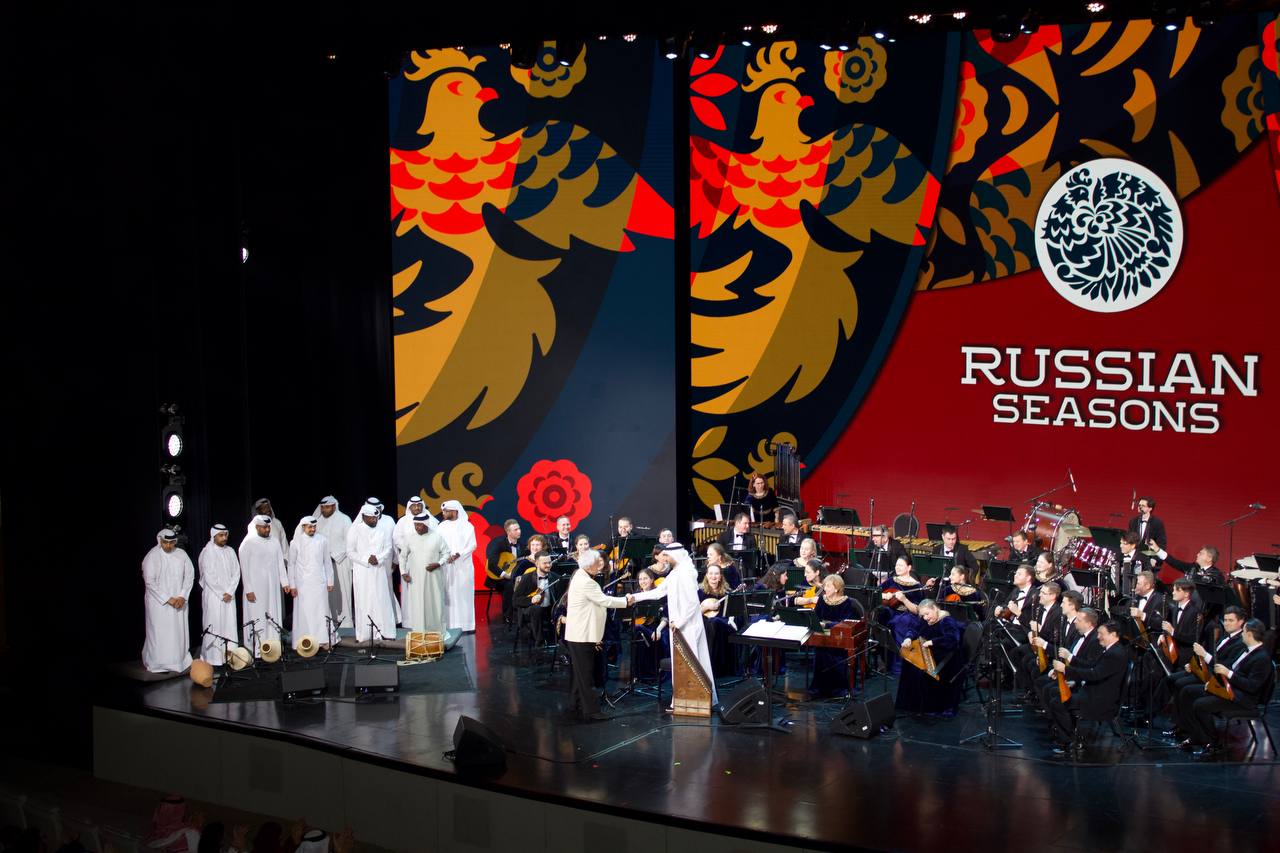
On 14 November, the closing concert of the “Russian Seasons” in the Kingdom of Bahrain featured the Ossipov National Academic Orchestra of Folk Instruments of Russia, conducted by People’s Artist of the Russian Federation Vladimir Andropov. Last year the orchestra celebrated its 105th anniversary. The distinctive sound of its folk instruments and the highest professional level earn the orchestra a place of honor among the unique phenomena of Russian art.
A surprise at the concert was the joint performance of the composition “Since the Creation of the World, We Are the People of Bahrain,” with lyrics by Sheikh Isa bin Rashid and music by Ahmed Al-Jumairi, by the Ossipov Orchestra and Bahraini musicians. The Bahraini musicians, in turn, joined the Osipov Orchestra in performing the famous Russian folk song “The Moon Shines,” using such rare instruments as the kanun and oud.
State Secretary and Deputy Minister of Culture of the Russian Federation Zhanna Alekseeva, in her speech to the guests and organizers of the evening, noted that in recent years cooperation between Russia and Bahrain has reached a qualitatively new level.
“Openness to dialogue, love for their homeland, and a respectful attitude toward traditions undoubtedly unite people in Russia and Bahrain. Thanks to this project, we have all become closer to each other, learn about the best examples of our countries’ cultures, and reached a better understanding. This is the true mission of any cultural project. We plan to expand our cooperation and cover such important areas as cultural education, librarianship, and folk art. We also see great potential in expanding our concert and touring activities. We certainly look forward to the Bahraini Cultural Days in Russia, scheduled for 2026,” she said.
On 15 November, at the Cultural Hall, musicians from the Ossipov Orchestra held a master class for children studying music. They talked about the history of Russian folk instruments—the balalaika, domra, gusli, button accordion, and the exotic Bashkir kurai—and gave those interested the opportunity to try playing these instruments, much to the children’s delight.
***
The “Russian Seasons” project in the Kingdom of Bahrain ran throughout the year. During this time, Bahraini audiences were introduced to performances of the Mariinsky Theatre Symphony Orchestra under the baton of People’s Artist of Russia Valery Gergiev, the “Lezginka” State Academic Honored Dance Ensemble of Dagestan, and young residents of the Kingdom tried their hand at creating animated films under the guidance of artists from the “Soyuzmultfilm” studio.
A working meeting was also held on the sidelines of the event between Zhanna Alekseyeva, State Secretary and Deputy Minister of Culture of the Russian Federation, and Farah Matar, Director General of the Kingdom of Bahrain Authority for Culture and Antiquities. The meeting was devoted to summing up the project’s results and outlining joint plans for 2026.